Kisaju, Kajiado CountyMon – Sat, 8 AM – 5 PM

Maxset 50 Fine Refractory Mortar 1500°C

  • Mortar
  • Fine grade
  • 1500°C

Mortar is specified with the brick, not instead of it. Maxset 50 Fine joints firebrick courses and beds shapes, rated to 1500°C maximum service temperature.

A lining is only as good as its joints: a brick rated to 1800°C bedded in a mortar rated lower fails at the mortar. Check the mortar against the brick you are laying. Supplied in 25 kg bags.

Fine is the 0.5 mm grade, for thin joints. The manufacturer also makes a Normal grade at 1.5 mm for coarser work; it is not held here, so ask if a job needs it.

Request a QuoteAsk on WhatsApp

Prices are quoted, not published. What the price of refractory cement and castables depends on, and what to send us.

Used for

  • Jointing firebrick courses
  • Bedding refractory shapes
  • Pointing and repairing brick linings

Request the technical data sheet for Maxset 50 Fine Refractory Mortar — 1500°C.

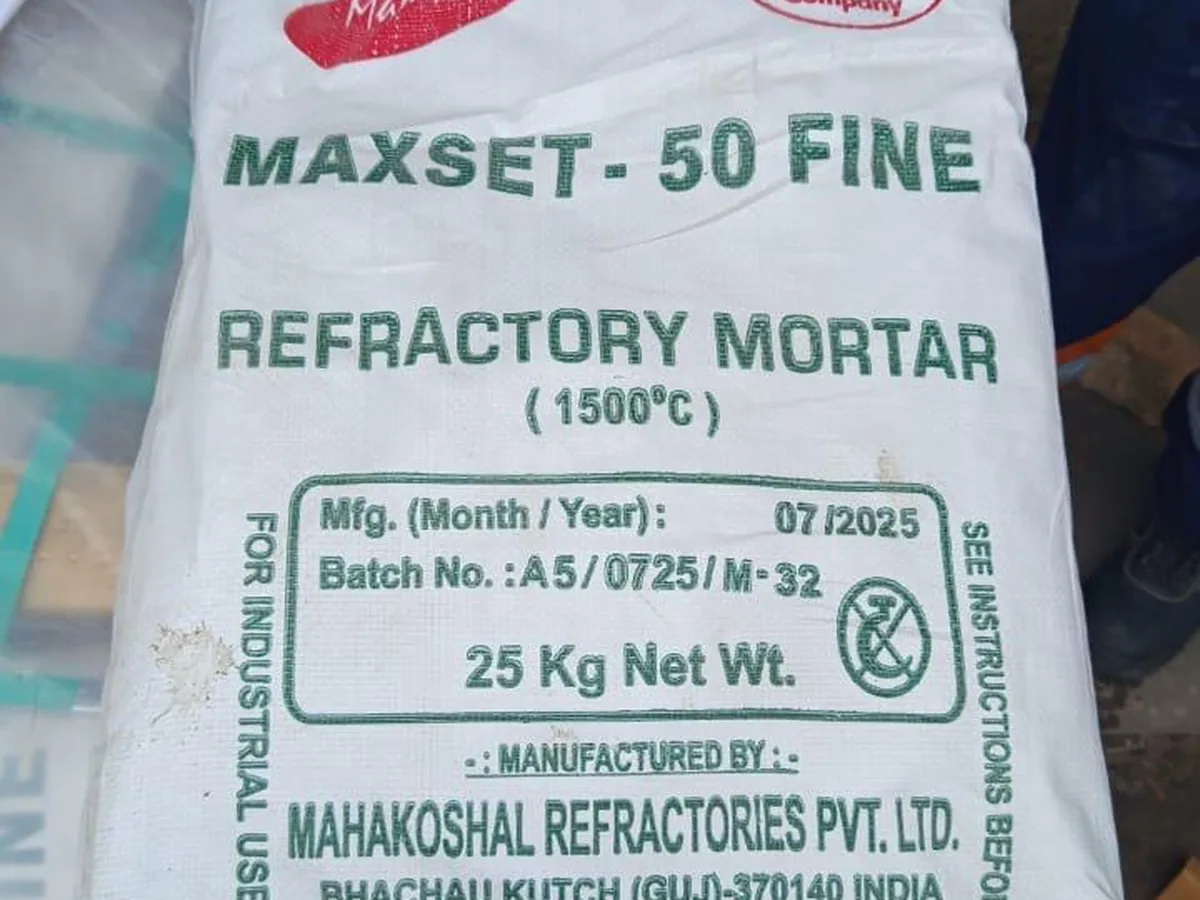
25 kg Mahakoshal sack printed Maxset-50 Fine refractory mortar, 1500°C
Type
Refractory jointing mortar, chemical / ceramic bond
Grade
Fine — 0.5 mm maximum grain
Base
Calcined bauxite
Alumina
49.2% Al₂O₃
Silica
35.55% SiO₂
Iron oxide
3.40% Fe₂O₃
Max service temperature
1500°C
Sintering temperature
1100°C
Pyrometric cone equivalent
Orton 31 / 1683°C
Water, trowelling
24 – 28%
Water, ramming
10 – 12%
Transverse strength
23.0 kg/cm², dried 100°C / 24 h
Storage life
9 months, dry
Pack
25 kg bag

Figures from the Mahakoshal Refractories mortar data sheet, for the Fine grade specifically. Ask for the sheet itself if you are specifying against it.

Sizes stocked

1 size on the stock list. Ask for anything not listed and we will quote to your specification.

  • Refractory Mortar Maxset 50 - Fine 1500°C 25Kgs Bag

About Maxset 50 Fine Refractory Mortar — 1500°C

Two water ratios, for two different jobs

This is the figure most often got wrong on a mortar. Maxset 50 Fine takes 24 – 28% water for trowelling and 10 – 12% for ramming — not a range to pick the middle of, but two different mixes for two different applications.

Mix it at trowelling consistency and ram it and the joint shrinks; mix it at ramming consistency and trowel it and it will not wet the brick. Decide which you are doing before the water goes in.

It is a jointing mortar, not a castable

Maxset 50 bonds brick to brick. It is not poured as a lining and it is not a repair filler for a large section; that is what Maxheat A and K are for.

The Fine grade stocked here has a 0.5 mm maximum grain, which is what lets it close a thin joint. A coarser grade would hold the brick apart.

Nine months, and then it is not the same product

Storage life is nine months dry. A chemically bonded mortar does not simply get weaker past that — it stops behaving predictably, and a joint is not where you want to discover it.

Buy it against the job rather than against the discount, keep it dry and off the floor, and date the bags when they arrive.

Questions we get asked

What is the sintering temperature for?
1100°C is where the chemical bond gives way to a ceramic one — the joint stops relying on the setting chemistry and starts being fired together. Below it the mortar still works; the figure matters when you are deciding whether a lining will ever reach the temperature that makes the joint permanent.
Is it rated as high as the brick?
1500°C maximum service, which is below the 70% alumina brick at 1750 – 1800°C and below Maxheat A. On a hot face the joint can be the limiting part of the lining, so check the mortar rating against the brick rating rather than assuming they match.

Castable grades: which one?

GradeRated toChoose it for
Maxheat A Castable, 1750°C1750°CThe hottest hot faces: complex shapes and repairs where brick cannot be coursed.
Maxheat K Castable, 1600°C1600°CGeneral-duty linings and repairs up to 1600°C.
Maxlyte 11 Insulating Castable1300°CBack-up layers behind the hot face, to cut heat loss and weight.
Maxset 50 Refractory Mortar, 1500°C1500°CJointing and bedding firebrick, where the brickwork does the work and the mortar holds the course.
Fondu Max-50 Cement, 1000°C1000°CMixing your own refractory concrete, and where a fast set matters more than peak temperature.
Expanded Vermiculite, 1100°C1100°CFilling a cavity or a flue, where the fill insulates and carries no load.

Send us your material list

A specification, a BOQ or a photo of the label on the old stock is enough to start. We reply with an itemised quotation.

Or call or WhatsApp 0722 293 517