For electrical contractors and plant safety officers
Insulating matting is specified by class, and the classes are defined by two different voltages. Confusing them is how switchrooms end up with matting that is either inadequate or several times more expensive than the job needed.
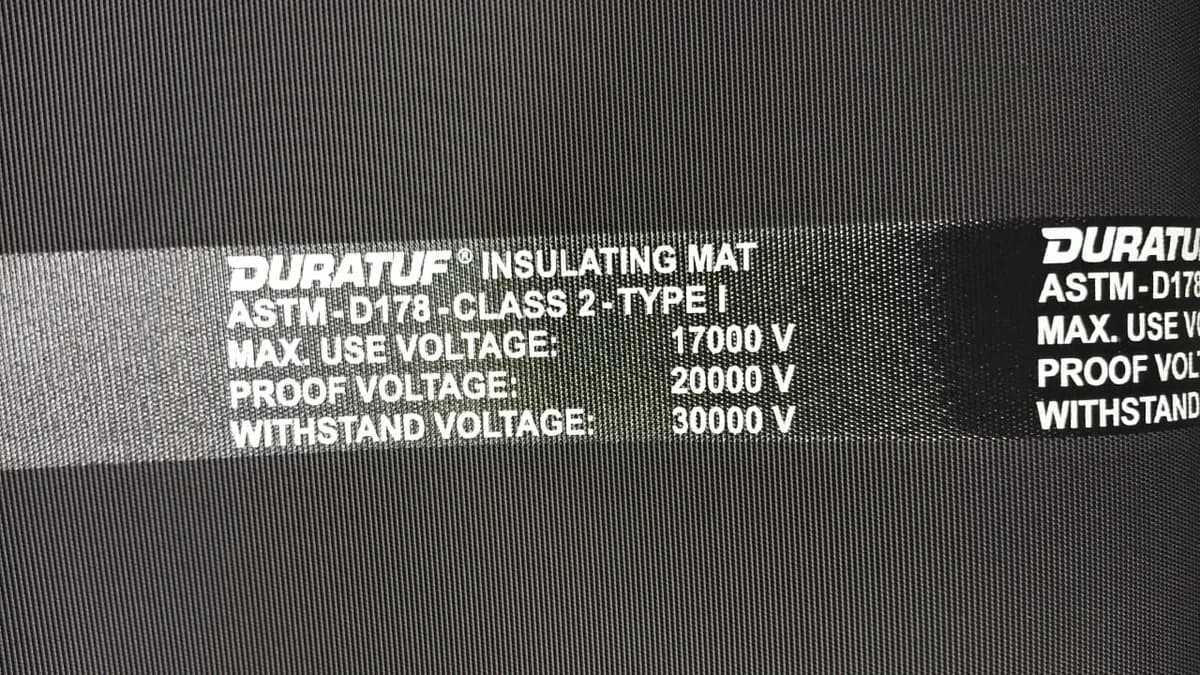
We stock Class 0, 1, 2 and 4 Duratuf matting, made to ASTM D178, supplied 1m wide and cut per metre from 10m rolls.
Working voltage is the number you specify against
Each class carries a maximum working voltage — the voltage the matting is rated to be used in front of, continuously, as part of normal operation.
Class 0 is rated 1 kV working. Class 2 is 17 kV. Class 4 is 36 kV. That is the figure to match against the equipment the matting sits in front of.
Test voltages are not ratings
Each class is also tested at two higher voltages, an AC proof test and a dielectric test. On the Duratuf data sheet: Class 0 at 5 kV and 10 kV, Class 1 at 10 kV and 20 kV, Class 2 at 20 kV and 30 kV, Class 4 at 40 kV and 50 kV. They demonstrate a margin above the maximum use voltage.
Neither test figure is an operating rating, and neither must ever be used as one. Matting rated 1 kV is tested at 5 kV proof and 10 kV dielectric; it is not 10 kV matting. Specifying from the dielectric figure gives a tenfold overestimate of what the matting is qualified for.
What the standards cover
ASTM D178 and IEC 61111 are the two specifications for insulating matting — the first the American standard, the second the international one. The figures on our pages are from Duratuf's ASTM D178 data sheet; ask us if you need IEC 61111 certification confirmed for the rolls in stock. Both define the class system, the test regime and the dielectric performance each class must demonstrate.
Specifying matting as compliant with a standard means little without the class. Ask for both, and keep the certification with the equipment records.
Choosing, in practice
Match the class to the working voltage of the switchgear it fronts, and specify the width to cover the full working position — matting that a technician can step off while reaching a panel is doing nothing.
- Class 0 — up to 1 kV working: LV distribution boards and control panels
- Class 2 — up to 17 kV working: medium-voltage switchgear
- Class 4 — up to 36 kV working: primary substation switchrooms
One thing we will not do
We supply the matting and its certification. We do not specify electrical safety equipment on your behalf, and this guide is not a substitute for your own electrical engineer or safety officer confirming the class against the installation.
Tell us the working voltage and the area to cover, and we will quote the right class and the metres you need.
Send us the duty and we will confirm the specification against the manufacturer's documentation.
Request a quote